'Worst ever’ debt crisis puts IDA’s financial model at risk, underscoring need for ambitious donor contributions to IDA21 replenishment – Bretton Woods Project
The 21st replenishment of the International Development Association’s (IDA21) – the World Bank’s low-income lending arm – due to conclude in December, takes place amid a worsening debt crisis. Even if IDA21 lives up to calls from World Bank President Ajay Banga for record breaking funding, the unfolding debt crisis will likely limit IDA’s ability to provide highly concessional loans and grants to its low-income country (LIC) members.
When an IDA country faces debt difficulties, its loans can be converted to grants, though this support is capped according to unpublished country quotas. From 2020 to 2022, as LICs struggled with the exogenous fallout of the Covid-19 pandemic and their debt situations worsened, the ratio of grants- to- loans in IDA’s portfolio rose from one-fourth to one-third. IDA began converting loans of moderately debt distressed LICs to 50-year credits instead of its usual mix of credits and grants which, according to Clemence Landers and Hannah Brown from US-based think tank Center for Global Development (CGD), should restore grants to a manageable level.
However, according to Development Finance International, the current debt crisis is the ‘worst ever’, with many LICs now paying more on debt servicing than on health, education, social protection and climate combined, meaning this crisis could place significant strain on IDA’s funding model.
The strength (and weakness) of IDA’s funding model: market-based finance
Since its 18th replenishment (2017-19), IDA has issued market debt backed by its equity base, mostly comprised of its outstanding loans (see Observer Winter 2017). This approach has allowed IDA to grow its resources to $185 billion. In IDA20, $23.5 billion of donor contributions were leveraged into a $93 billion replenishment, $33.5 billion in borrowing and $36 billion in reflows via repaid debt from IDA members. As long as grants are less than contributions, IDA does not have to dip into its equity base – but if it does, it could cause a larger contraction in its loan portfolio because its equity is the basis on which it raises market finance.
According to CGD’s calculations, a moderate worsening of LIC debt dynamics would require at least $36 billion in grants over the IDA21 replenishment cycle, requiring an additional $12 billion in contributions compared to IDA20 to avoid dipping into IDA’s equity base. A significant worsening would require at least $45 billion in grants over the replenishment cycle, requiring an additional $22 billion, compared to IDA20. As donor contributions to IDA have fallen by 20 per cent in real terms over the last decade and, as CGD notes, many large donors have signalled that reaching even the level of their contributions for IDA20 may prove difficult, even the moderate debt crisis scenario could significantly affect IDA.
Advertisement
As debt repayments surge and capital flows turn net-negative, LICs have been forced to rely on IDA for affordable finance, while high-income countries have persistently failed to meet their 0.7 per cent GNP target for Official Development Assistance or agree on a new allocation of SDRs (see Observer Summer 2024).
Quality vs quantity
However, concerns about the size of the IDA21 replenishment should not obscure more fundamental questions of how effective IDA assistance has been: only 17 out of 81 IDA countries have graduated out of IDA eligibility since 1996 (see Observer Spring 2024).
IDA assistance remains linked to highly problematic policies that have a strong pro-liberalisation, deregulation and private sector bias. This has favoured profit extraction by international investors, been linked to the financialisation of Global South economies, and has failed to catalyse economic transformation (see Report, Financialisation, human rights and the Bretton Woods Institutions: An introduction for civil society organisations). This approach looks set to continue in IDA21, with the draft policy package released on 17 June containing numerous references to efforts to crowd in private finance into climate and development efforts.
“IDA is of critical importance for the 39 African states that rely on its financing. But just ensuring it can continue current levels of support is not enough,” noted Jane Nalunga of Ugandan civil society organisation SEATINI. “We need a better IDA, that actively supports their economic transformation, not just keeps them on life support, and to do this we need rich countries to increase their contributions to substantially reduce IDA’s reliance on market finance.”
There are plenty of AI stocks whose valuations have surged amid the current AI boom. There are now three companies worth at least $4 trillion, six companies worth at least $2 trillion, and 15 companies worth at least $1 trillion. And of the 15 companies worth at least a trillion, 13 are tech companies.
One of the newest members of the trillion-dollar club is Micron(MU 1.05%), which had a market cap of $1.07 trillion as of the market close on July 8. The stock is up more than 660% in the past 12 months and 200% this year, making investors a lot of money along the way — including President Donald Trump.
Trump’s 2025 financial disclosure showed that he owned between $1.67 million and $6.65 million in Micron stock. Should Trump’s stake in Micron be a sign that investors should follow his lead?
Image source: The Motley Fool.
At the right place at the right time
Trump’s stake in Micron is noteworthy given the company’s $250 million commitment to the president’s “Trump Account.” But when you set that aside, the investment in Micron is a matter of striking while the iron is hot.
Advertisement
Micron is a memory chip maker and has found itself at the right place at the right time during the current AI boom. As AI hyperscalers such as Amazon, Microsoft, and Alphabet have spent billions building out data centers and other AI infrastructure, there has been a shortage of memory hardware that these data centers rely on to operate.
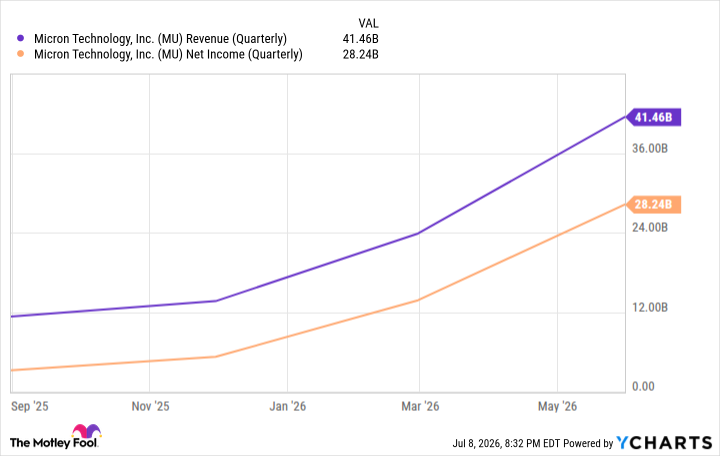
Given the high demand and short supply, Micron has been able to considerably raise prices and improve its profits and margins (though it has been accused of collusion and price-fixing). In the past year, Micron’s revenue has increased by 266%, while its net income has surged by 782%.
MU Revenue (Quarterly) data by YCharts
Unsurprisingly, the unique position Micron has found itself in — both financially and in terms of market position — has attracted many investors hoping to capitalize on it. And based on the president’s latest disclosure, he’s been one of those investors.
Today’s Change
(-1.05%) $-10.39
Advertisement
Current Price
$981.25
Key Data Points
Market Cap
$1.1TMarket cap calculated using publicly traded shares outstanding only. Does not include unlisted, private, or dual-class non-traded shares. Implied market cap may vary.Market cap calculated using publicly traded shares outstanding only. Does not include unlisted, private, or dual-class non-traded shares. Implied market cap may vary.
Day’s Range
$954.13 – $998.00
Advertisement
52wk Range
$103.38 – $1255.00
Volume
859.4K
Avg Vol
Advertisement
51.2M
Gross Margin
72.60%
Dividend Yield
0.05%
Advertisement
Should you follow Trump’s lead?
You shouldn’t invest in Micron simply because the president did. It’s true his stake in the company means he has a vested interest in making sure the stock does well, but you don’t want to blindly follow his moves simply for that reason.
You should, however, consider investing in Micron because its unique market position is bound to last for the foreseeable future. But even when supply meets demand, and Micron can’t command the premium it’s currently charging, the company will still have long-term agreements in place.
It’s operating in a cyclical industry that’s riding the high end, but it’s still a solid company with good long-term potential. It’s likely to be highly volatile along the way, but I trust its trajectory.
GRAND FORKS — Student loan repayment options and federal PLUS loans are seeing the biggest changes with the implementation of the federal One Big Beautiful Bill Act, said the director of student finance at the University of North Dakota.
Matt Lukach said students will see minor changes, but most of the work to make the alterations will fall upon UND’s system.
“It’s going to create work on our end, though, because all these changes will be manual, so we will have a lot more work on the back end. But hopefully, our students won’t see too much of a change from past years,” he said.
On Wednesday, July 1, changes to federal student aid programs from the OBBBA went into effect. Of the changes, Luckach sees the removal of the SAVE (Saving on a Valuable Education) loan repayment plan, the removal of the Graduate PLUS Loan Program and the alteration to the Parent PLUS Loan Program and scheduled reductions for federal loans at the undergraduate level as the most significant.
For undergraduate loans, students previously could get their full federal loan even if they were not a full-time student taking 12 credits. Following the changes, loans will be pro-rated down, depending on how many credits a student is taking. Most of UND’s undergraduate students are full-time students, Lukach said. For part-time students, UND will work to make adjustments to loan offers early so they won’t be as affected if they need to find alternative funding. UND already makes schedule reductions for Pell Grant funding.
Advertisement
A big change that may affect graduate students is the removal of the federal Graduate PLUS Loan Program. Some graduate students have used it to fund living expenses and pay for shortfalls while they finish their program. Graduate borrowers who have had a PLUS loan disbursed before July 1, 2026, while enrolled in a program, can continue to borrow for three academic years or the remainder of their program, whichever is less. Newer graduate students won’t be able to get the loans, and Lukach has seen movement in the private loan sector to balance this.
“We have had a lot of traffic, a lot of movement in the private loan sector in the last year to come up with options to help fill that gap of graduate PLUS loans,” he said. “The private educational loan industry is doing a pretty good job of coming up with some really comparable options to that loan.”
The Parent PLUS Loan Program won’t be going away, but it will be capped. Eligible parents can borrow a maximum of $20,000 per aid year per dependent student. In the past there was no cap, but Lukach said there wasn’t a high percentage of parents borrowing more than $20,000.
In Lukach’s opinion, the financial aid changes will be minor to current and incoming students. The bigger changes, he said, are in student loan repayment.
The SAVE plan, PAYE (Pay As You Earn) plan and the ICR (Income-Contingent Repayment) plan all are being phased out. Loan servicers are reaching out to current borrowers notifying them they have to choose different plans, though they can pay through the ICR plan until July 1, 2028. Their other options include a new tiered standard repayment plan and the new Repayment Assistance Plan.
Advertisement
RAP allows borrowers to pay monthly payments of 1-10% of the borrower’s income based on their adjusted gross income, with a minimum monthly payment of $10.
“I honestly don’t know what the effects of these new plans will be yet, because we’ve not heard from anybody, and they just went into effect,” Lukach said. “I’m sure we’ll see some chatter in the next few months on that (RAP) to see if it looks good, bad, the same. It’s hard to tell if it will be a benefit or a detriment to those people who are on the SAVE plan. We’re real early in this.”
New borrowers who borrow loans on or after July 1, 2026, have the options of the new tiered repayment plan or RAP.
Same as any other year, Lukach offers students this advice: Make a financial plan and know what is needed.
UND also has a monthly payment plan to cover gaps between a student’s charges and their financial aid, something Lukach has noticed students use more over the years. Overall, he’s seeing students be more fiscally responsible.
Advertisement
“It’s a good sign,” he said. “It means we have really high-quality students at the University of North Dakota, which I really, really love.”
A new bipartisan bill making its way through Congress aims to protect seniors and other vulnerable people from scams by allowing some financial institutions the ability to pause transaction requests while they investigate potential fraud.
The Financial Exploitation Prevention Act would give open-end investment companies, including mutual funds, the ability to pause redemption requests from people 65 and older or people with disabilities when the institution believes financial fraud or exploitation is at play.
“Financial exploitation is a huge problem in this country,” said Nina Kohn, an elder law expert at the Syracuse University College of Law. Artificial intelligence is also helping fraudsters become more sophisticated and making it harder for people to avoid scams, she added.
Financial abuse cost older victims nearly $2.4 billion in 2024, according to incidents reported to the Federal Trade Commission. The agency noted in its annual report that the estimate of total losses include “only a fraction” of older adults harmed by fraud due to underreporting.
Three people accused of being behind a major romance fraud scheme targeting older adults were indicted by the Department of Justice in May, part of a series of cases that have charged 11 others from the U.S. and Ghana with wire fraud and money laundering.
Advertisement
“The concern is, in part, that individuals may lose their life savings,” Kohn said.
“So financial institutions and entities that are holding individuals’ money can be empowered to help put the brakes on scams by delaying disbursement to a suspected victim,” she added.
READ MORE: As losses from scams surge, Congress asks telecoms to do more to prevent them
The bill passed the House in a 414-2 vote last month, while a similar bill resides in the Senate, though it’s not clear if or when the banking committee under that chamber will consider the legislation.
The overwhelming support for this bill shows “there’s broad agreement that protecting seniors from financial exploitation shouldn’t be a partisan issue,” said Rep. Andrew Garbarino, R-N.Y., one of the bill’s co-sponsors, in an emailed statement to PBS News.
Advertisement
The legislation gives these financial institutions additional tools to “recognize when something isn’t right and help stop financial abuse before the damage is done.”
Here’s what to know about the bill.
What would the bill do?
The bill would allow a financial institution that manages investments, such as mutual funds and some exchange-traded funds, to temporarily halt requests to access funds that it “reasonably believes” might be exploitative.
The bill focuses on requests from two specific groups:
Someone age 65 or older
Any adult the financial institution “reasonably believes has a mental or physical impairment that renders the individual unable to protect” their own interests.
It doesn’t require the institutions to carry out the pauses or investigate potential fraud. But there is a proposed framework for delays. The institution can put a hold on the request for up to 15 business days while companies notify a client-provided adult contact that the customer may be the victim of financial exploitation. There are steps an institution can take to extend the hold for another 10 days. A court, state regulator or another administrative authority could also extend the delay.
The bill does not apply to other financial institutions, like banks or credit unions. It does require the Securities and Exchange Commission to submit a report to Congress with recommendations on how to further reduce financial fraud targeting these adults within a year of enacting these measures.
Advertisement
The Financial Industry Regulatory Authority, or FINRA, already allows brokers and money managers to temporarily freeze requests that are from older adults who may be the victims of exploitation.About half the states also have laws on the books that allow banks and sometimes credit unions to do the same.
This federal legislation “fills a gap,” Kohn said, by covering investment funds that are self-managed.
How this bill could help
The Department of Justice identified more than 1 million victims of all forms of elder financial exploitation, fraud, neglect and abuse between July 2024 and June 2025. Offenders allegedly stole or attempted to steal $2.3 billion, according to the department’s latest annual report to Congress.
There are no national reporting standards for how often financial institutions detect exploitation, and when they do, how often they put holds on accounts, said Marti DeLiema, associate professor at the University of Minnesota School of Social Work.
WATCH: How human trafficking victims are forced to run ‘pig butchering’ investment scams
Advertisement
But some state-level data does exist. In Minnesota, of the 286 cases referred for investigation in 2022, temporary holds were implemented in a quarter of them, according to a study DeLiema co-authored.
Half of the banks who responded to a 2024 survey from the American Bankers Association Foundation said they had delayed disbursements or refused or held transactions when they suspected exploitation.
And more than 85% of banks in states without hold laws said they would find them beneficial, the survey found.
“Financial institutions are seeing this stuff is happening. They want to help,” DeLiema said. Sometimes, a conversation from the bank or law enforcement is enough to pull the victim from the scam, she said.
Other times, that’s not enough.
Advertisement
In those cases, temporary holds can be used as a “last resort” to keep the person and their money safe.
Concerns and questions about autonomy
For Kohn, it’s not clear whether the pauses proposed by the bill will prevent the exploitation entirely or just delay it. Putting holds on customers’ accounts also puts financial institutions at risk of degrading trust with their clients.
While 43% of banks in the ABA Foundation survey said they found state hold laws useful in preventing financial exploitation among older people, 45% also said customers reacted negatively to those holds. Nearly 17% said customers closed their accounts after a delay, and 2.4% said the hold has been challenged in court.
Another concern is someone’s self-determination. Allowing financial institutions to stop customers from accessing their own money may verge into limiting people’s ability to make choices about their lives and their own funds, Kohn said.
“The question is: Is that restriction on self-determination justified?” she said.
Advertisement
Giving people the opportunity to make their own decisions, even bad ones, is called “dignity of risk,” a term often used in disability studies.
For example, people are allowed to take their retirement funds and spend it at a casino, DeLiema said, so “why would we stop them from participating in a scam?”
“The answer has to be: The people on the other end are criminally victimizing these individuals. They’re using deception, they’re lying,” she said.
That exploitation leads victims to believe they’re in a relationship with their scammer, or that they’re rescuing a grandchild, or that their money is being invested in cryptocurrencies, she said.
With the rise of deepfakes and other AI-driven technology being used in scams, “all this is going to get a lot worse,” she added.
Advertisement
WATCH: How to recognize and block AI-powered scam attempts
It’s reasonable for policymakers to be concerned about exploitation among older adults in particular, because they tend to lose more money than younger adults and have less time to recover financially, Kohn said.
But she also worries that legislation based on age may perpetuate stereotypes against older people.
If financial holds are good policy, why limit their application, she said.
“I think that speaks to our willingness as a society to curtail the self-determination and financial independence of older adults and people with disabilities to a degree that we are not comfortable curtailing the self-determination and financial independence of other adults,” she said.
Advertisement
A free press is a cornerstone of a healthy democracy.